A board walkthrough that keeps a named AI system inside organisational purpose and values
This walkthrough is for the governing body and the people who write its papers. It records why the organisation exists, which values bind it, and how the intended purpose of a named AI system stays inside those bounds after approval.
King V expects the board to oversee data, information, technology and emerging technologies, including AI. That oversight has nothing to stand on if the system's purpose was never written down.
Boards are often asked to approve AI while three different meanings of purpose are collapsed into one sentence:
If there is no written baseline, mission creep is not a later risk. It is how the system will run - and non-compliance follows.
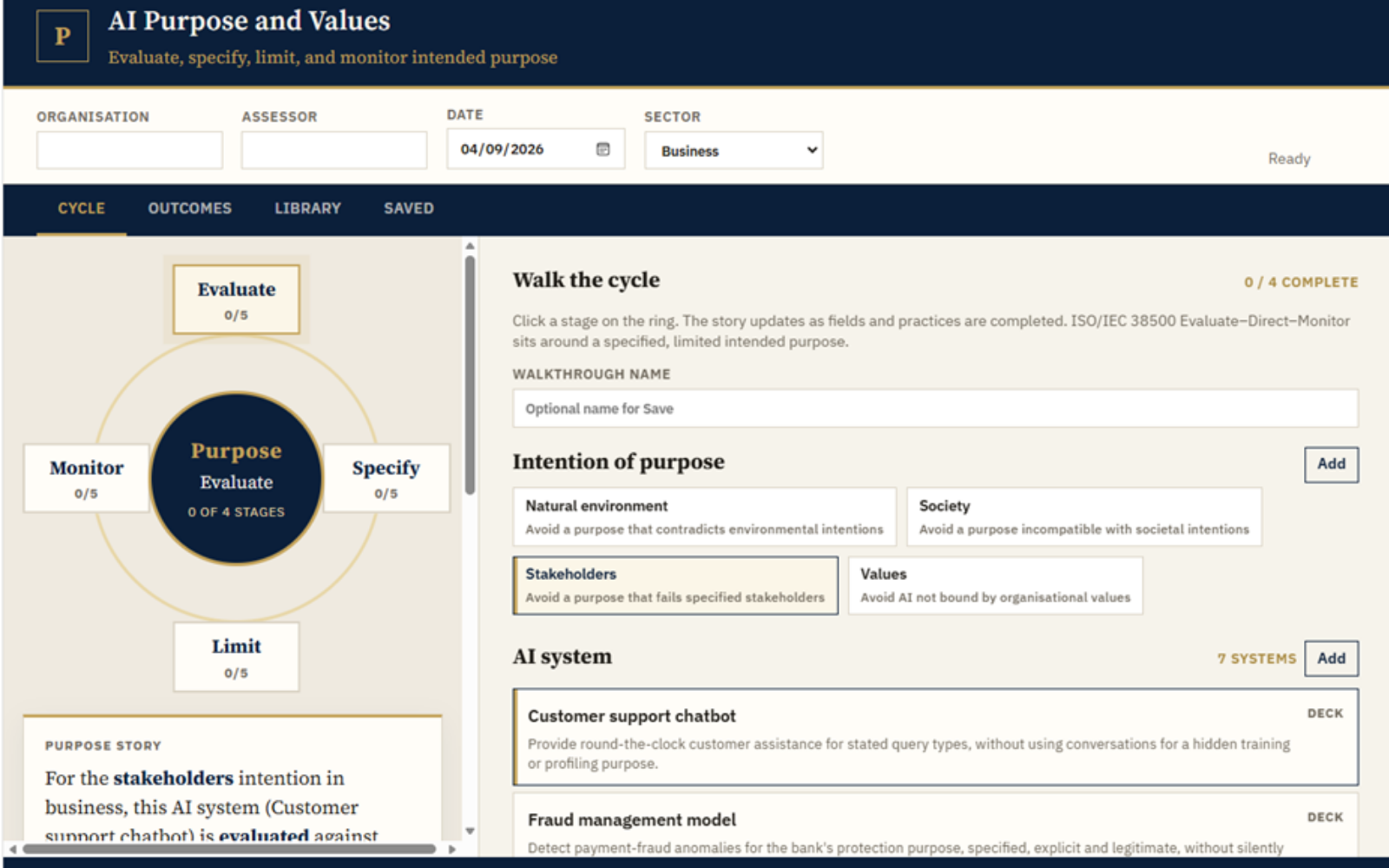
AI Purpose and Values takes one named system through a four-stage ring. As fields are completed and practices ticked, a plain-language purpose story is built and stored with that system's evidence pack.
It is the purpose-and-values module of the Govern AI suite. Sister modules deal with leadership, oversight, value generation and viability. This page is only purpose and values.
| Stage | What the board is asked to settle |
|---|---|
| Evaluate | Is organisational purpose clear? Are values defined? Can this AI enable that purpose without contradicting those values? |
| Specify | Is this system's intended purpose specified, explicit and legitimate - a real use case, not "develop a generative model"? |
| Limit | What further use is compatible? What is excluded? What misuse is reasonably foreseeable? How is mission creep controlled? |
| Monitor | Is management still inside the approved purpose? Has technology or use moved it? A change of intended purpose is a material change. |
Purpose sits at the centre. The ring is Evaluate, Specify, Limit, Monitor. The walk can be paused, saved and resumed.
A completed walkthrough produces a board-readable purpose story and a structured record that other processes can use. The record can be saved in the workbench and exported as JSON, PDF or Word for the system's evidence pack.
These are walkthrough records, not conformity certificates.
The Outcomes record captures the board's determination of which results of using AI for purpose apply:
Intended purpose becomes a board artefact. Classification, instructions for use, performance assessment and "substantial modification" all depend on a written intended purpose. This walk produces that baseline before those processes have to invent one.
Three meanings of purpose stay stacked, not collapsed. Organisational purpose under King V, POPIA processing purpose, and AI Act intended purpose (where the Act reaches you) are related and not the same. The workbench keeps them in view so a slogan such as "development of a generative AI model" cannot pass as specified, explicit and legitimate.
Change of purpose is treated as material. Monitor is not a dashboard. It is an instruction to hold management to account against the written purpose, and to treat a change of intended purpose as a material event - the same idea that sits behind substantial-modification and change-of-use gates.
Values constrain the system, not decorate it. The library offers recognised value sets (including ISO/IEC 38507 and the HLEG principles) and an editable example statement. The useful outcome is a short list of values that actually bound this use - and the exclusions that follow from them.
The workbench does not replace the processes that consume its output. It is not a legal opinion, a PIIA, a DPIA or an EU AI Act conformity assessment. It is not a signed policy register, and it is not a high-risk classifier. It supplies the intended-purpose clarity those processes need.
Organisational purpose and values set the boundaries for an AI system's intended purpose. Those boundaries stay checked over time.